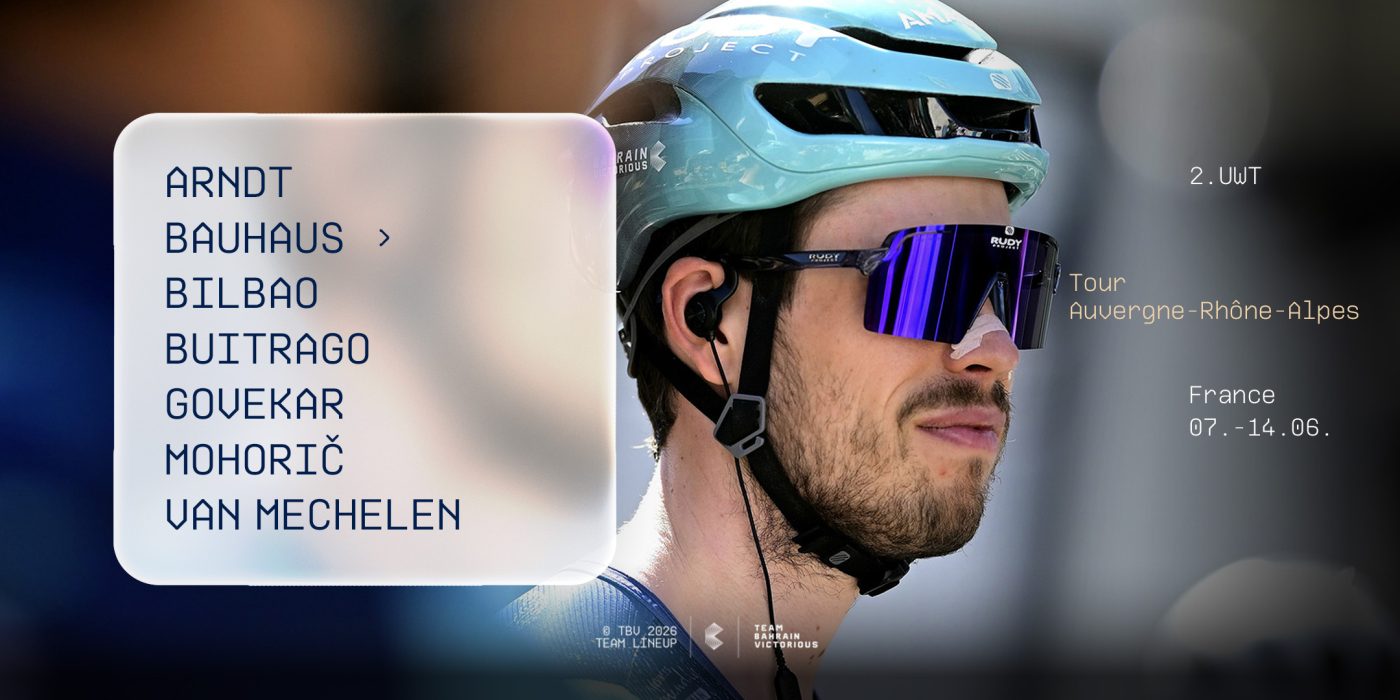
With the Giro d’Italia just behind us, another group of Bahrain Victorious riders are ready to take on the first stage race in preparation for the next Grand Tour, the Tour de France: the newly named Tour Auvergne-Rhône-Alpes, formerly known as the Critérium du Dauphiné.
Aside from its new identity, which pays tribute to the host region and its ongoing commitment to the event, the race remains faithful to its traditional formula. Now in its 78th edition, it will feature eight stages from Sunday, June 8, to Sunday, June 15, across a predominantly mountainous and hilly route. Covering approximately 1,200 kilometres from Vizille to Plateau de Solaison, the race offers opportunities for breakaway specialists and climbers targeting the overall classification, but sprinters can also shine.
The opening stage and the final three stages will be demanding mountain tests, while the remaining four stages include a team time trial and three hilly stages, only one of which is potentially suited to the pure sprinters.
Sports Director Michal Golaś outlined the team’s ambitions:
“This year’s route is highly demanding, but we will take advantage of our riders’ different strengths to target results on several stages. We want to approach this race as if every day were a one-day race. Almost every rider in our lineup will have an opportunity to go for a result on the stage that suits them best.
Mohorič will certainly be one of them. Bauhaus will be our main option in a bunch sprint, while Govekar could be a strong contender if the sprint comes from a reduced group. And why not, our young Van Mechelen if a breakaway makes it all the way to the finish.
When it comes to the mountain stages and summit finishes, our man will be Buitrago. However, he is returning to racing after crashing out of the Giro d’Italia. Although his injuries were not serious, he had to rest for a couple of weeks. We’ll see how the first few days go and how he feels toward the end of the week.
We will also keep an eye on the general classification, especially during the final weekend, when the overall standings will be decided. With the reliability of our road captain Arndt, I’m confident the boys will work well throughout the week to support Bilbao, who will be vigilant in avoiding any time losses in the general classification.”
Like Mohorič and Van Mechelen, Pello Bilbao will also pin on a race number for the first time in more than a month. The Basque rider completed his first racing block of the season with an excellent spring campaign, highlighted by sixth place at Liège-Bastogne-Liège and a strong performance at Eschborn-Frankfurt, where he narrowly missed the podium.
“I’m eager to race again. As this is my final season, I’m trying to enjoy every moment and create good memories. I’ve trained well, although a minor health issue over the last few days means I may not start this race feeling at my very best. But it’s a long week, and although we face demanding stages right from the beginning, I hope to feel better day by day as we approach the crucial final weekend.”
With four summit finishes and plenty of climbing, the race promises plenty of action in the battle for the overall classification.
The challenge begins immediately with Stage 1 (Vizille – Saint-Ismier, 146.2 km), featuring five categorised climbs and almost 3,000 metres of elevation gain.
Stage 2 (Saint-Martin-le-Vinoux – Le Puy-en-Velay) will be the longest of the race at 237.3 km. Once again, riders will face five categorised climbs, although on paper they appear less demanding than those of the opening stage.
Stage 3 features a team time trial, serving as an important rehearsal ahead of the Tour de France. The 28.4 km course starts and finishes in Perreux and includes two short climbs that could prove decisive. The route concludes with a short but steep ramp of 0.8 km at 7%, which could significantly influence the final times.
Stage 4 (Le Puy-en-Velay – Montrond-les-Bains, 167.4 km) offers a rolling route divided into two distinct sections. The opening part is highly undulating, characterised by constant ups and downs. Riders will then tackle the remaining climbs in quick succession, with little opportunity to recover, for a total of six categorised ascents. The final 30 km are entirely flat.
Stage 5 (Saint-Chamond – Parc des Oiseaux, Villars-les-Dombes, 195.8 km) represents the final genuine opportunity for the sprinters before the race heads into its decisive mountain phase.
The crucial final block begins with Stage 6 (Saint-Vulbas – Crest-Voland, 182 km), featuring nearly 3,000 metres of climbing. After a relatively flat start, the first significant difficulties arrive around the halfway mark. Approximately 23 km from the finish, riders will face the demanding combination of the Côte d’Héry-sur-Ugine (11.3 km at 5.1%) and the Côte du Crest-Voland (5.9 km at 7.7%), where the finish line is located.
Stage 7 (La Bridoire – Grand Colombier, 133.6 km) may be shorter, but it packs more than 3,700 metres of elevation gain and five categorised climbs. The stage concludes with a challenging summit finish atop the Grand Colombier, climbing 8.4 km at an average gradient of 10.2%.
The race concludes with Stage 8 (Beaufort – Plateau de Solaison-Brison, 120.1 km), the ultimate showdown for the general classification. Over just 120 km, riders will tackle more than 4,000 metres of elevation gain, including two first-category climbs, one Hors Catégorie ascent, and a demanding final climb. The decisive ascent to Plateau de Solaison-Brison is 11.3 km long at an average gradient of 9.1% and is set to determine the winner of the 2026 Tour Auvergne-Rhône-Alpes.